James Lovelock of the Gaia hypothesis died recently at his home along the Chesil Beach, on his 103rd birthday.
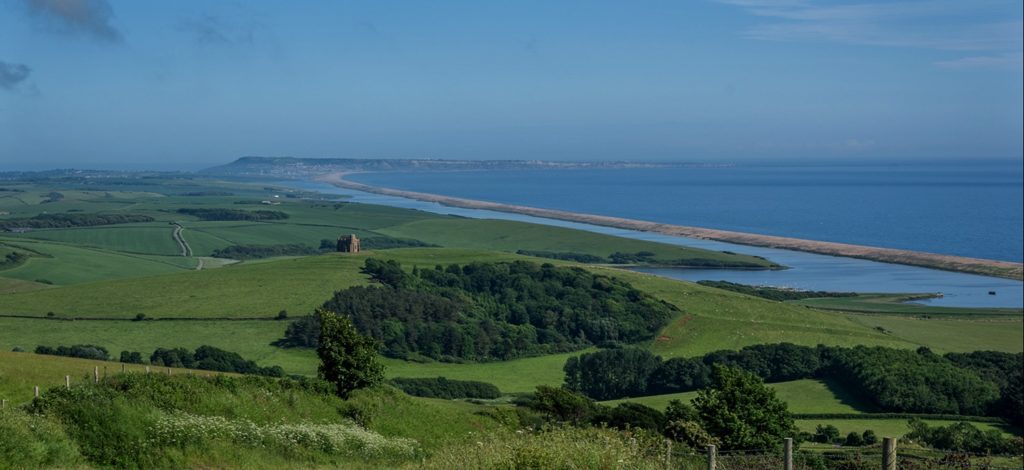
Chesil Beach from Abbotsbury Hill © James Loveridge 2022
Hothouse Earth by Bill Mcguire lets us know how dire the environmental situation is already, and how that’s likely to progress. The Invisible Rainbow by Arthur Firstenberg documents the price we’re paying in health and wellbeing for all the toys, gadgets, and appliances which make our lives more comfortable and convenient. Kerryn Higgs showed in Collision Course how we had to be brain-washed into consumer culture, and how ever-increasing resource consumption is simply not possible on a finite planet.
We haven’t been in balance with the natural world since about 1970: instead, we’ve been living on an ever-increasing overdraft, and shown no inclination to rein in our consumption. In An Inconvenient Apocalypse, Wes Jackson and Robert Jensen argue that since we’ve shown no sign of curbing our appetites, societal collapse is now inevitable. We are caught in a big Ponzi scheme, and “We know how Ponzi schemes tend to end.”
Before the Civil War, Eunice Newton Foote first realized the CO2 problem through simple experiment. Robert Oppenheimer and Edward Teller explained the situation to the oil industry in 1958 and 1959. Since the oil industry’s own research in the 70’s and 80’s, the climate issue has been known and clearcut. But the problems we’re facing, and especially the next couple of generations, are bigger and more inter-related than that. It’s also about resource consumption, loss of biodiversity, the mega-drought in the American southwest, the river levels of the Danube, Loire, Po, Murray and Colorado, the draining of the aquifers, eating a credit card’s worth of plastic a week, an unsustainable economy……
It was mooted in 1994 that the earth’s sustainable population, at the European rate of resource consumption (half that of the US) is around 2 billion people. As Richard Heinberg says: “until society changes its basic operations, which are currently wildly unsustainable, the overall risk of collapse sometime this century is overwhelmingly large.” Any successful species exploits its environment until the environment can’t sustain that activity any longer. The species’ numbers collapse, the environment recovers – the cycle continues. When you have an intelligent species exploiting its world, the growth habit is much more successful and much harder to break. If you want to know how – and why – this is likely to end, just watch The Big Short, based on Michael Lewis’s book. The people who run the politics and economies are still crooks, greedy and short-sighted crooks. And virtually all of us are dependent on and complicit in this system, especially for pension funds and housing values.
More accurately we can call it the Global Environmental, Ecological & Resource Emergency. Given the way we treat the planet, it’s pretty clear that underlying that, is a crisis of consciousness, of egoic sense of self, of values, of ethics, of perception, of dealing with reality. We use the boiling frogs metaphor, except that we are the frogs, and we’re boiling ourselves.
If there’s one book to read for inspiration and vision as well as specific steps required as a matter of extreme urgency, it would be The Children of the Anthropocene by Bella Lack. Read and give copies to anyone you know.
A planet that behaves as a ‘superorganism’ with a self-regulating ‘physiology’, capable of feedback loops providing the conditions for life to develop and evolve will, sooner or later, produce – evolve – self-conscious beings. This follows from Lovelock’s Gaia hypothesis, and before him, Teilhard de Chardin described its progress.
We’re generating catastrophic conditions that threaten humanity far more than the planet. The inertia and vested interest in the political and economic system guarantees the collapse of civilization. In looking for a way forward there’s a clue: A consciousness shift, not based on a subjective sense of self looking out from somewhere behind my eyes, with a new appreciation of vital energy, is required that be can in a much deeper, more workable relationship with our world.
It’s possible that previous (evolutionary) shifts in consciousness and have been precipitated by massive upheaval and crisis, so even civilization collapse is not necessarily a “bad” thing. Whole system change will be happening, whether or not it suits our notions and social conditioning. We shouldn’t expect to be comfortable.
When people absorb enough Qi / BG3 (Biogeometry) energy, they become centers, then beacons and transmitters. The corrections we place on the earth lines extend beyond beyond the confines of the property. Working to turn electrosmog devices into Qi / BG3 carriers makes us healthier, and frees our systems up to develop that consciousness, hopefully becoming saner in the process.
When we perceive the earth as a living being, some things just seem obvious. ‘Deep ecology’ is not a political program with a list of items on its agenda. It’s about one’s conscious, deeply felt, intuitively-sensed relationship in primary perception with the energies of a living earth. In native American ceremonies, it’s the drum beating at the heart rate of a new-born infant. It’s feeling the energy of sacred spaces wherever we are, and why any particular space is sacred:
“It is not sacred because it is a place people go and pray. It has nothing to do with religion. It has everything to do with the fact that it is the birthplace of three salmon-bearing rivers.” ~ Terry Brown: The Sacred Headwaters: The Fight to Save the Stikine, Skee and Nass.
It is expanding and sending energy and consciousness out into the natural world, whether planting or weeding in the yard, whether hiking through a forest or standing to watch a sunrise. All perception is reciprocal, and we can energize the reciprocation.
The Gaia hypothesis says that the planet behaves as a ‘superorganism’ with a self-regulating ‘physiology’, capable of feedback loops providing the conditions for life to develop and evolve will, sooner or later, produce – evolve – self-conscious beings.
Gaia produced a conscious species capable of drastically altering the planet itself (might happen with any conscious species on any life-bearing planet). That species inevitably has to learn how to deal with, and be responsible for, the consequences of their actions. It will also have to face up to the mindset that justified it all. You can probably see why a crisis will precede change. There will need to be a new, vastly different relationship with a living planet before coming up with “action plans”.
Mother Earth needs her offspring, our energy, perception and consciousness, to move evolution forwards.

“The earth itself is changing in proportion to the level of human conscious awareness.” Dr. Pang Ming
© Malcolm Fraser 2022. All rights reserved.